 Pro Ski USA
 Pro Ski Canada
 English
 Deutsch
 Slovenščina
On this page
- No motor, and the machine itself needs no power socket — every movement comes from you.
- Resistance comes from elastic ropes: Junior 6 × 1.0 m, Classic 6 × 1.5 m (6 levels), Power 8 × 2.0 m (up to 8 levels).
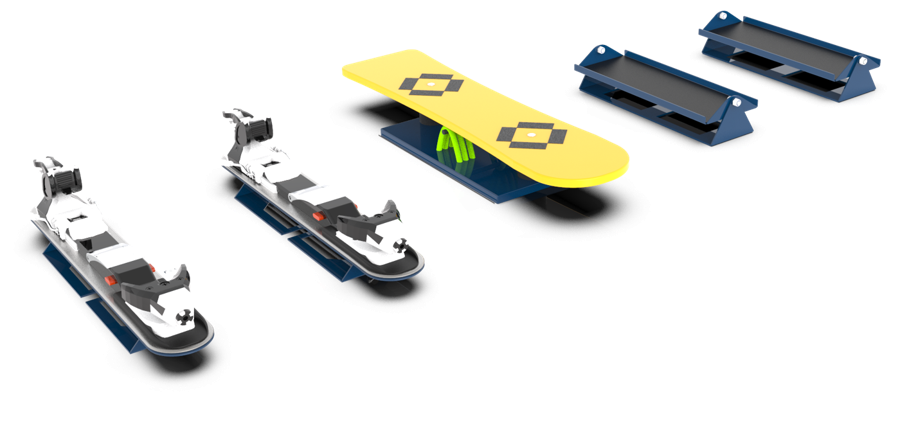
- Three discipline modules clip onto the cart: foot pedals (sneakers), a snowboard deck, or bindings for your own ski boots.
- Two carts: the fixed cart (foot pedals, never upgradable) or the modular all-in-one cart.
- Optional tech: the Pro Ski App or the Pro Game Set 360.
The idea in one sentence
A ski simulator takes the one movement that makes skiing skiing — the side-to-side pendulum of a carved turn — and puts resistance on it, so you can train it at home, every day, without snow.
On a slope, a turn is not an up-and-down movement and not a twist. Your body travels across your skis: you move your centre of mass towards the inside of the turn, tip the skis onto their edges, load the outside ski, and then release that load so the body can travel back across into the next turn. Linked turns are that lateral pendulum, repeated. A lateral ski trainer isolates exactly this, and it is why the machine moves sideways and nowhere else.
The four parts of the machine
1 · The frame
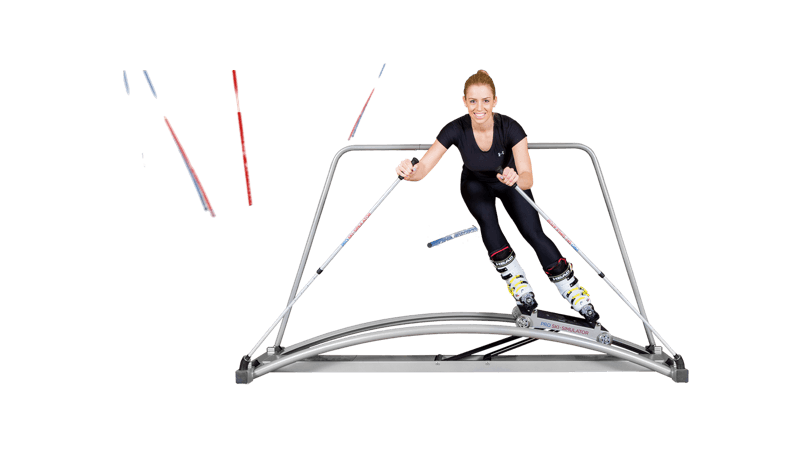
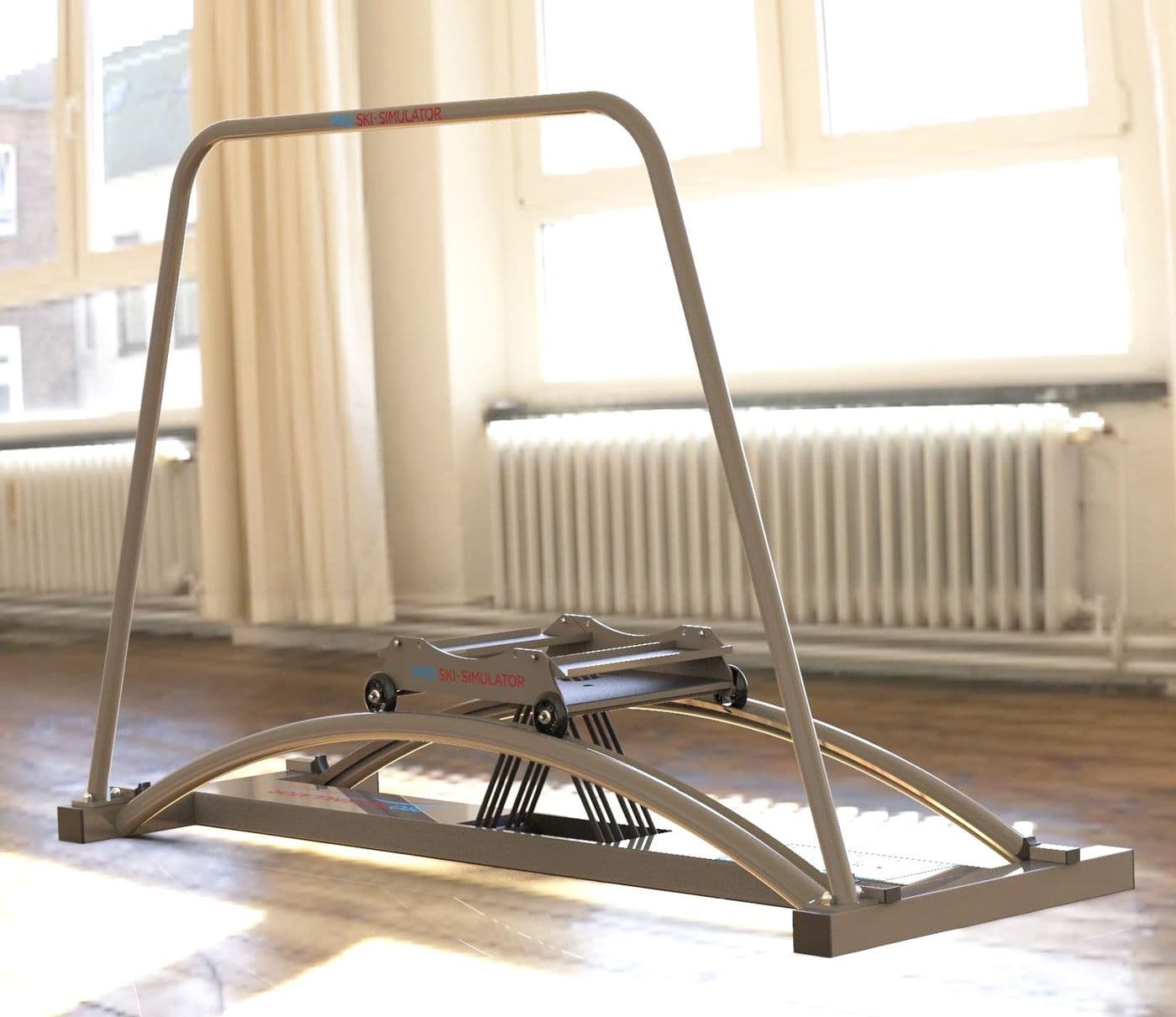
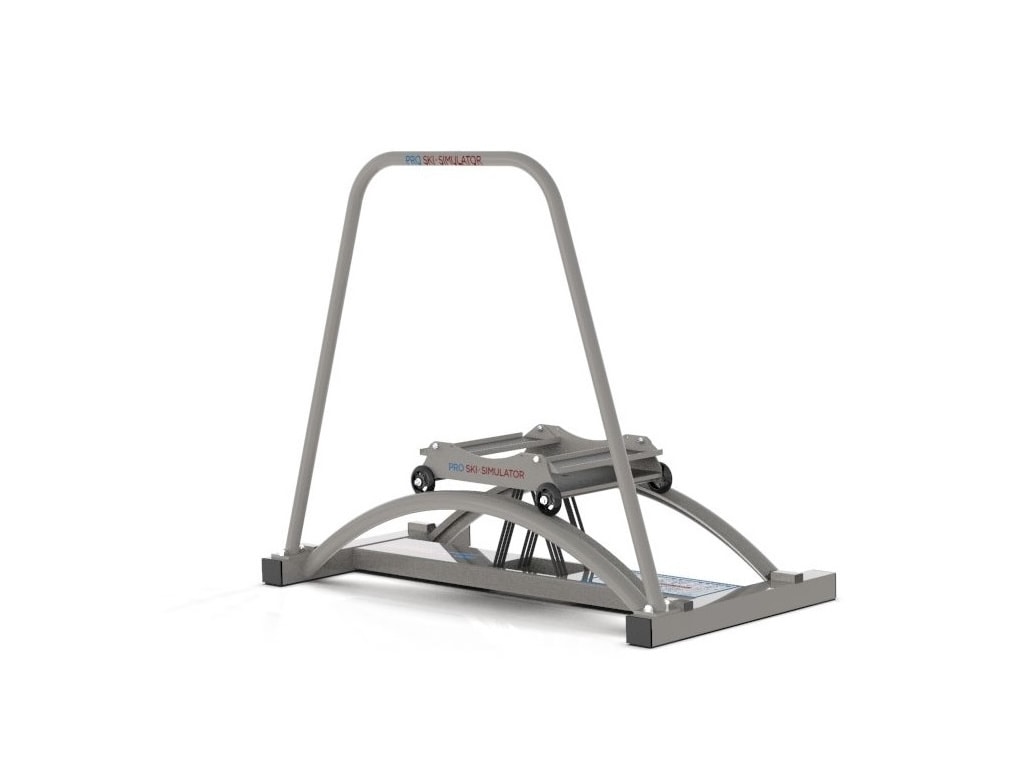
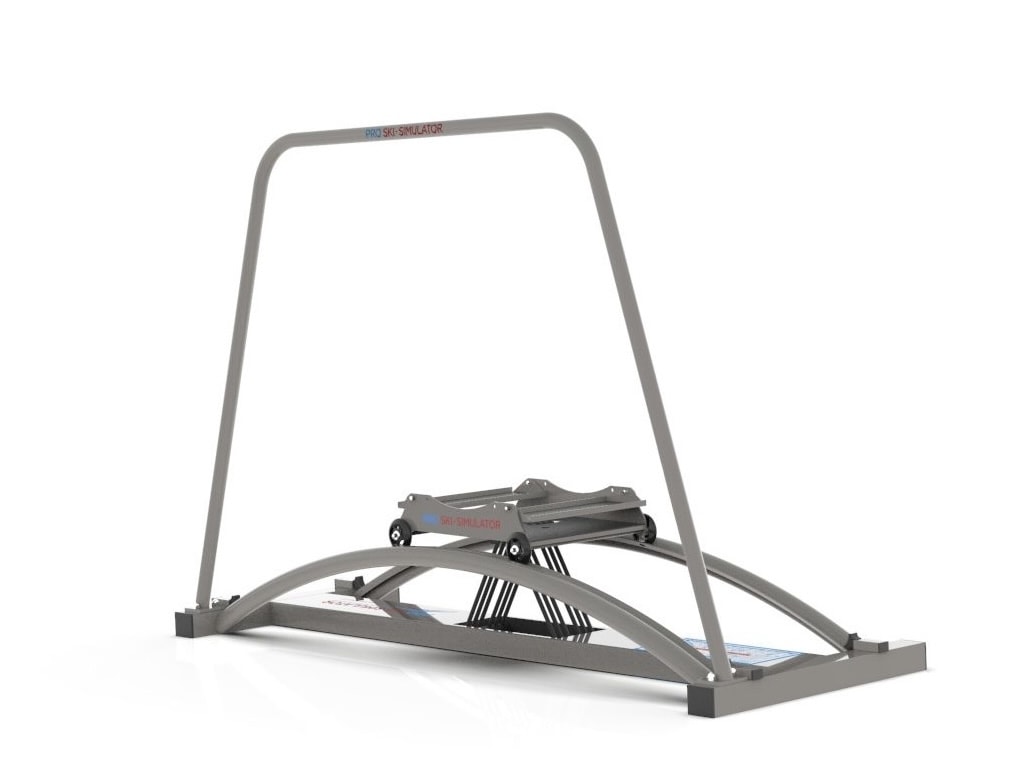
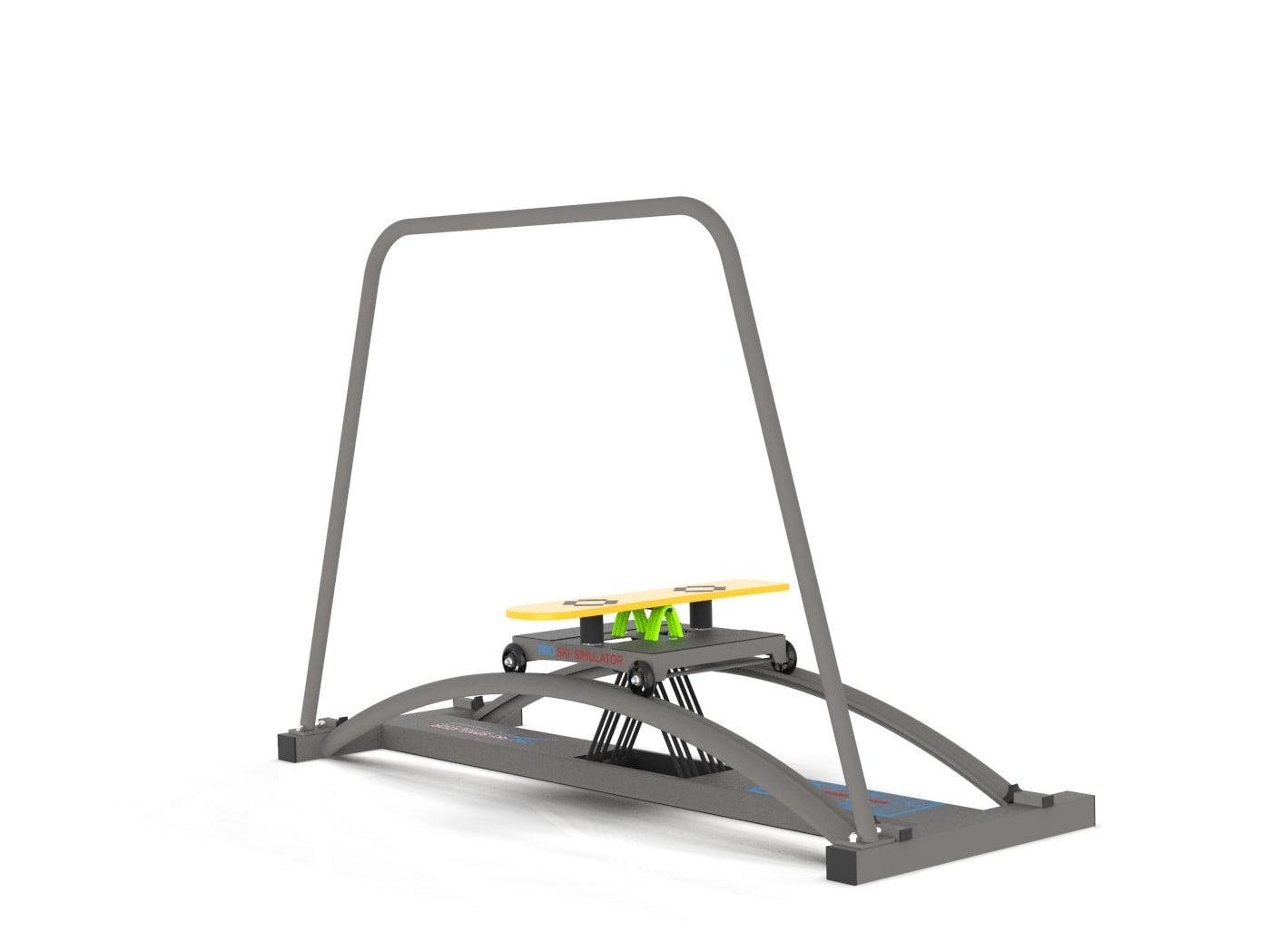
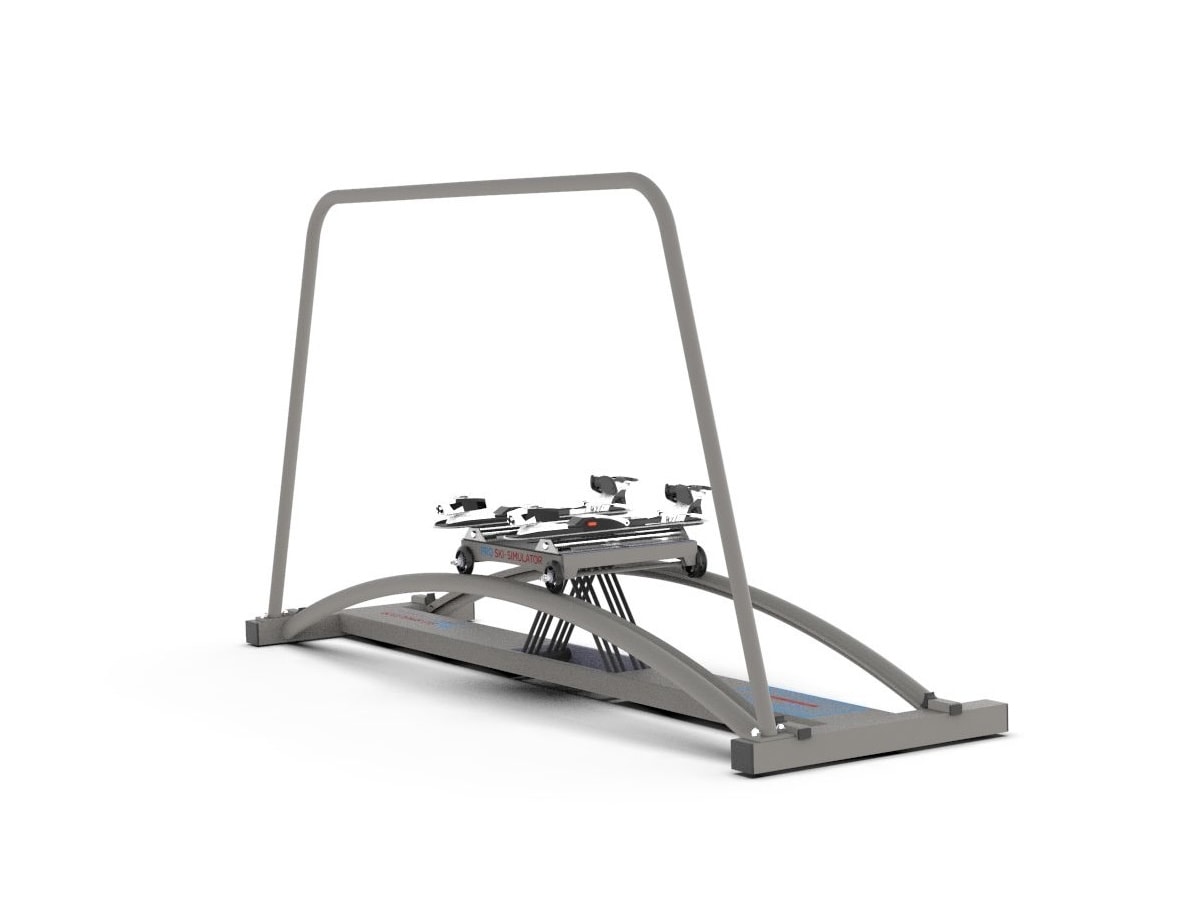
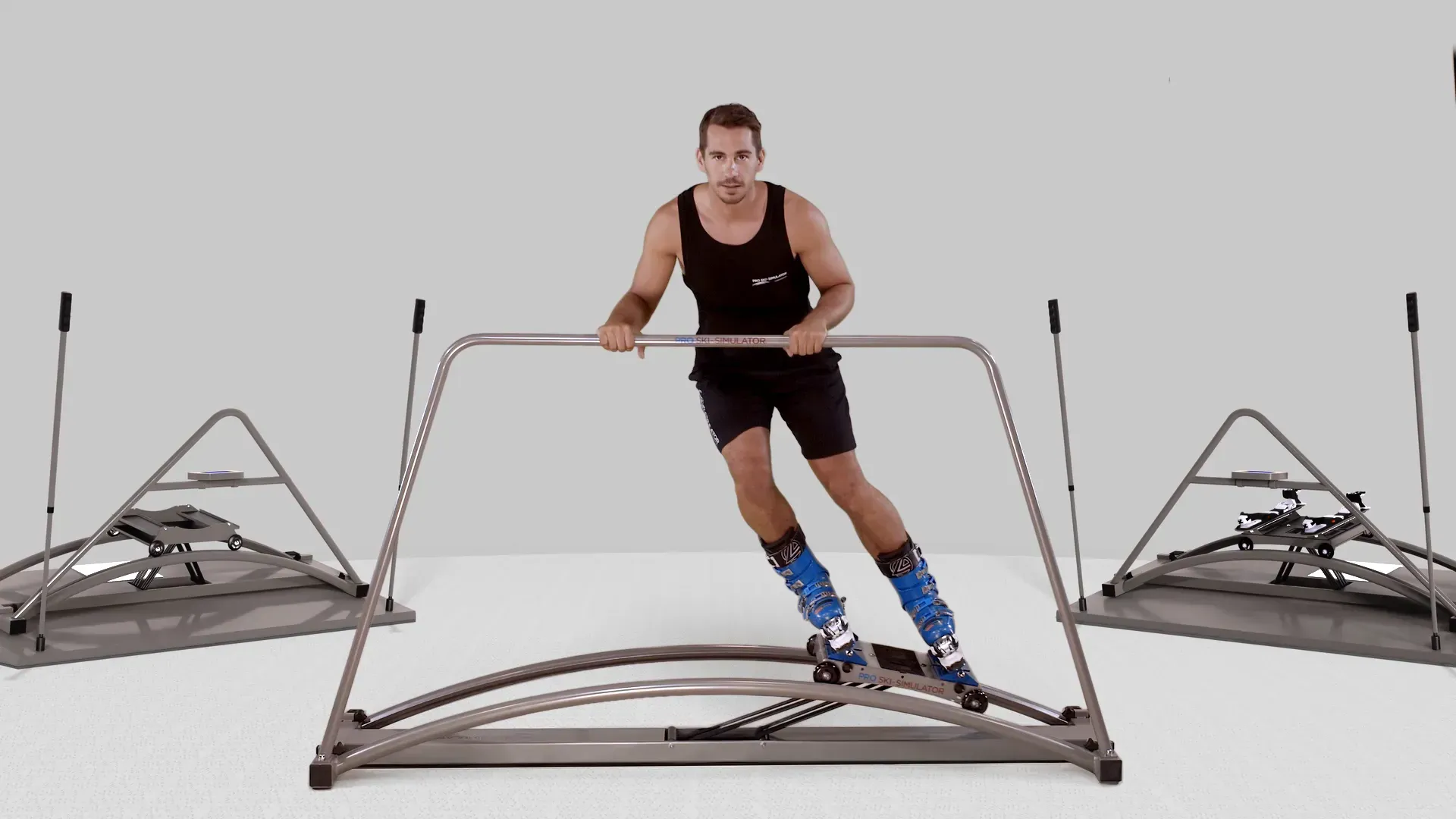
The frame is the base the whole machine stands on: a steel structure with two curved rails and an upright hand holder at the front. The curve of the rails is what gives the movement its shape — as the cart travels out to the side, it follows the arc, the way your body follows an arc through a turn. There are three frame sizes: the compact Junior frame (125 × 68 × 105 cm assembled) for children up to 145 cm and shorter adults, the full-size Classic frame (173 × 68 × 125 cm) for most adults, and the XXL Power frame (219 × 68 × 125 cm) for advanced skiers, racers and daily club use.
The hand holder is there for balance, not for support. Beginners hold it lightly; advanced skiers barely touch it, or swap it for poles.
2 · The cart
The cart is the moving part. It rolls on wheels along the rails, from one end of the frame to the other, and carries whatever you stand on. When you push with your legs, the cart moves; when you stop pushing, it stops. There are two kinds: the fixed B-type cart with foot pedals built in, and the all-in-one cart, which takes interchangeable modules and has adjustable feet width.
3 · The elastic ropes
The ropes connect the cart to the frame. As the cart travels out to one side, the ropes on that side stretch and pull it back towards the centre — so the further you push, the harder it gets, just as the forces in a turn build towards its apex. Resistance is set by how many ropes you use: fewer ropes for children, technique work and fast cardio; more ropes for strength and race training.
Each frame comes with its own rope set: 6 × 1.0 m on the Junior, 6 × 1.5 m on the Classic (6 resistance levels), 8 × 2.0 m on the Power (up to 8 levels). The Professional and the SKI FIT 360 also have 6 levels. Ropes are consumables, so the warranty doesn’t cover them; spare sets are sold separately.
4 · The module
The module is what your feet stand on. The Sneakers module (B-type) has two foot pedals — you train in trainers. The Snowboard module (F-type) is a real board deck for your normal stance. The Ski boots module (P-type) takes bindings for your own ski boots, so ankle angles and boot pressure match the hill.
What happens in one turn
- Start centred. Feet hip-width on the pedals, ankles and knees flexed, hands resting on the holder. The ropes hold the cart in the middle.
- Push out. Drive the cart to one side by extending the outside leg and tipping both knees in the same direction. The ropes start to stretch and the resistance rises the further you go.
- Edge and hold. Near the end of the travel the platform tilts with you. This is the moment of the turn where you hold the angle — hips inside, upper body quiet and facing forward.
- Release. Soften the outside leg. The ropes pull the cart back through the centre; you guide it rather than letting it swing.
- Cross over and repeat. Your body passes over the cart and you push to the other side — the edge change. Slow and wide for technique, short and quick for cardio.
That is one pair of turns. A ten-minute session is a few hundred of them, and that repetition is the point: the movement pattern becomes automatic, and the muscles that hold it get stronger.
Why mechanical, not motorised
Motorised ski simulators move a platform or a slope under you and you react to it. A mechanical trainer works the other way round: nothing moves unless you move it. That has four practical consequences.
- You build the force. Every metre of travel is produced by your legs and hips, which is what builds ski-specific strength.
- It stops when you stop. There is no speed to fall behind; beginners and children set their own pace.
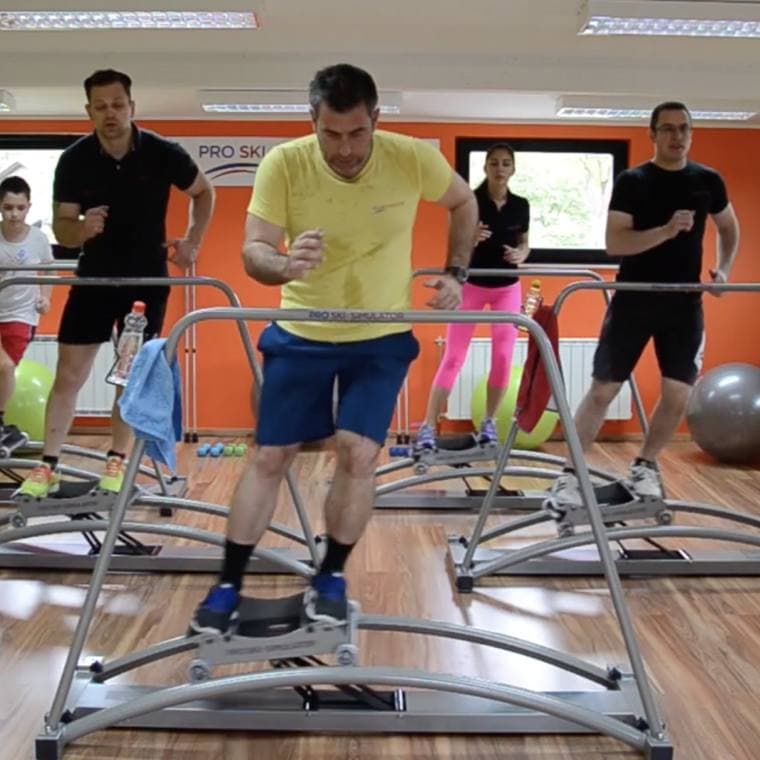
- It lives in a living room. No motor, no power socket, no installation — it needs floor space and nothing else.
- Little to maintain. Wheels, ropes and rails — with a silicone spray now and then.
The honest limitation: a simulator doesn't give you speed, terrain, snow or the feeling of a pitch. It trains the movement and the muscles that make those things enjoyable. The best results come from combining it with time on snow.
Choosing resistance and tempo
Two dials control every session: the number of ropes and the tempo. Few ropes and a quick rhythm make a cardio session; many ropes and a slow, deep push make a strength session. Technique work sits in between — moderate resistance, full travel, and time to feel each phase of the turn. The frame sets the ceiling: the Power frame with its 8 × 2.0 m set and up to 8 levels offers the most resistance in the range, the Junior the least.
A good rule for the first weeks: add time before you add ropes. If you can finish a session with clean, controlled turns on both sides, you're ready for more resistance.
Fixed cart or all-in-one cart
The fixed B-type cart has foot pedals built in. It is the simplest and most affordable way in: you train in trainers, on the pure mechanical machine, and that's it — it can't take other modules or tech later. The all-in-one cart is modular: it accepts the Sneakers, Snowboard and Ski boots modules (several at once), has adjustable feet width, and is the only cart that can take the App or the Game. If anyone in the house snowboards, wants to train in ski boots, or might want the tech later, choose the all-in-one cart.
Adding tech: App or Game
Both tech tiers sit on top of the same mechanical machine; neither drives it. The Pro Ski App connects to your phone on the phone holder by Bluetooth, rates every turn and measures speed and amplitude, footpad angles and left–right symmetry, with statistics after each session — for skiing only. The Pro Game Set 360 connects the machine to a Windows PC and puts downhill, slalom, giant slalom and an endless slope on your TV or projector, and works with the snowboard deck too. You can compare them side by side on the Game page.